- About
- Key Dates
- Program
- Destination
- Accommodations
- Call for Proposals
- Registration
- Sponsorship & Advertising
- Volunteers
Theme
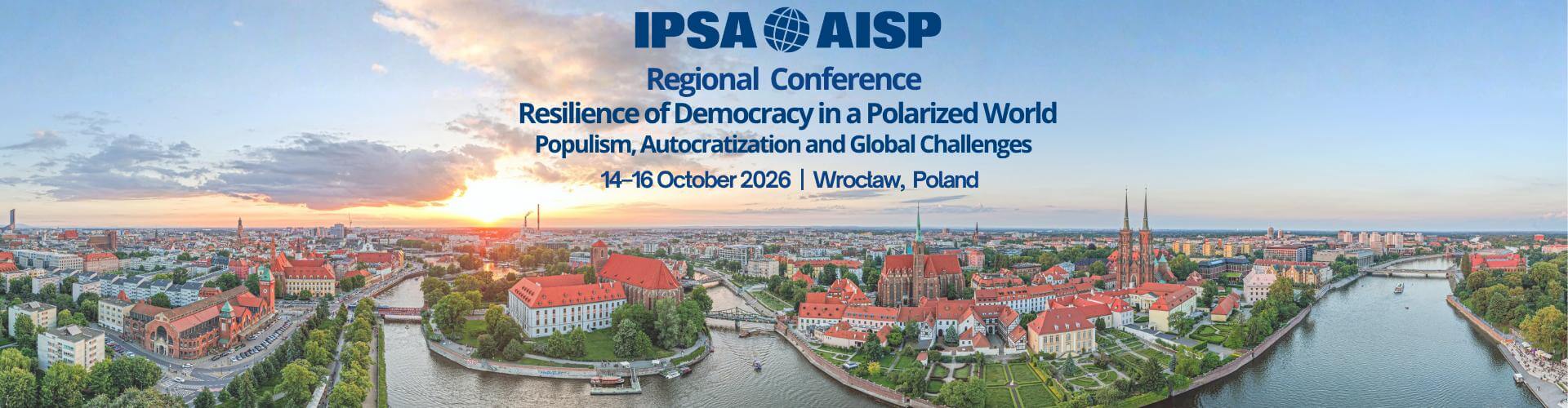
Resilience of Democracy in a Polarized World: Populism, Autocratization, and Global Challenges
Processes of democratic erosion, autocratization, and intensifying political polarization constitute some of the most consequential developments in contemporary politics. While the late twentieth century was widely characterized by successive waves of democratization, the early 21st century has witnessed a growing number of cases in which democratic institutions are weakened from within, executive authority is expanded, and the core principles of liberal democracy are increasingly contested.
These dynamics are closely intertwined with the rise of populist actors, the radicalization of political discourse, declining levels of trust in political institutions, and the strategic use of elections, media, and legal frameworks for partisan purposes. At the same time, such transformations unfold against the backdrop of profound global changes, including economic volatility, rapid technological innovation, climate change, large-scale migration, pandemics, and shifting security environments. Together, these developments reshape both the capacities of states and the expectations of citizens.
Yet democracy has not disappeared. Across different political systems, societies and institutions continue to develop mechanisms of adaptation, resistance, and renewal. The concept of democratic resilience directs analytical attention to the capacity of political systems to withstand pressures, respond to crises, and reconfigure democratic practices under adverse conditions. Explaining variation in democratic resilience—why democracy proves durable in some contexts and vulnerable in others - represents one of the central challenges for contemporary political science.
Importantly, contemporary democracies operate under conditions of overlapping and mutually reinforcing global pressures. Political responses to war and geopolitical instability, environmental degradation, economic shocks, public health emergencies, and technological disruption shape not only public policy, but also patterns of political competition, narratives of responsibility and blame, and the perceived legitimacy of democratic governance. Such responses may either strengthen democratic resilience through inclusion, accountability, and cooperation, or accelerate autocratization through securitization, exclusion, and the concentration of power.
Organizing a three-day regional conference in Poland in October 2026, convened in cooperation with the International Political Science Association (IPSA), the Polish Political Science Association (PPSA), and the Faculty of Social Sciences at the University of Wrocław, is therefore of particular relevance.
The conference will be a fully in-person event. No virtual component will be available.
The conference invites paper and panel proposals that examine democratic resilience, erosion, and transformation from theoretical, empirical, and comparative perspectives. Contributions addressing any region or time period are welcome, including both single-case studies and cross-national analyses, within the following thematic areas:
1. Threats and Erosions
Track Chairs: Elisa Chelle, Magdalena Musiał-Karg
Domestic and Global Autocratization
Democratic Erosion and Institutional Resilience
Populism, Polarization, and Party Realignment
Corruption, Trust, and Democratic Legitimacy
Judicial Independence, Judicialisation of Politics, and the Rule of Law
Electoral Integrity and Strategic Manipulation
2. Information, Media, and Technology
Track Chairs: Elisa Chelle, Luís de Sousa
Media, Disinformation, and Democratic Accountability
Digital Authoritarianism and Surveillance Politics
Virtual Public Spheres and Online Deliberation
AI and Governance
3. Citizenship, Participation, and Identity
Track Chairs: Laurence Piper, Hasret Dikici Bilgin
Civil Society and Grassroots Mobilization
Social Movements and Democratic Renewal
Youth Politics and Digital Participation
Civic Education and Democratic Citizenship
Nationalism, Identity, and Democratic Cohesion
4. Institutional and Policy Innovations
Track Chairs: Luís de Sousa, Piotr Sula
Participatory and Institutional Innovations
Clientelism and Accountability Mechanisms
Economic Crises and Inequalities
Digital Democracy
Political Parties and Electoral Reform
5. Global and Environmental Challenges
Track Chair: Hasret Dikici Bilgin
War, Securitization, and Democratic Order
Governing Global Challenges after Multilateralism
Climate Governance and Collective Leadership
Migration and Multi-level Policy-making
Traditional and Non-traditional Security Issues
Program Committee
- Yuko Kasuya (Co-Chair)
IPSA President, Professor of political science at Waseda University (Tokyo, Japan) - Magdalena Musiał-Karg (Co-Chair)
IPSA Vice-President, President of the Polish Political Science Association (PPSA), Professor of political science at Adam Mickiewicz University (Poznań, Poland) - Hasret Dikici Bilgin
IPSA President-Elect, Professor of political science at Istanbul Bilgi University (Istanbul, Türkiye) - Elisa Chelle
IPSA Executive Committee member, Professor of political science at Université Paris Nanterre (France) - Laurence Piper
IPSA Executive Committee member, Professor of political science at University West (Sweden) and the University of the Western Cape (South Africa) - Magdalena Ratajczak
Dean of the Faculty of Social Sciences and Professor of political science at the Institute of International and Security Studies at University of Wrocław (Wrocław, Poland) - Luís de Sousa
IPSA Executive Committee member, Principal researcher at the Instituto de Ciências Sociais da Universidade de Lisboa (Lisbon, Portugal) - Piotr Sula
Deputy Dean of the Faculty of Social Sciences, Associate Professor of political science at the Institute of Political Science at the University of Wrocław (Wrocław, Poland)
Local Organizing Committee (LOC)
- Magdalena Musiał-Karg
IPSA Vice-President, President of the Polish Political Science Association (PPSA), Professor of political science at Adam Mickiewicz University (Poznań, Poland) - Magdalena Ratajczak
Dean of the Faculty of Social Sciences and Professor of political science at the Institute of International and Security Studies at University of Wrocław (Wrocław, Poland) - Piotr Sula
Deputy Dean of the Faculty of Social Sciences, Associate Professor of political science at the Institute of Political Science at the University of Wrocław (Wrocław, Poland) - Maciej Hartliński
Associate Professor of political science at the University of Warmia and Mazury (Olsztyn, Poland) - Izabela Kapsa
Associate Professor of political science at the Kazimierz Wielki University (Bydgoszcz, Poland) - Łukasza Zamęcki
Associate Professor at the University of Warsaw (Warsaw, Poland) - Michał Jacuński
Associate Professor of political science at the University of Wrocław (Wrocław, Poland) - Dawid Pieniężny
Ph.D. Assistant Professor, University of Wrocław (Wrocław, Poland) - Adam Szymański
Associate Professor at the University of Warsaw (Warsaw, Poland)
Partners


Sponsor

Co-financed by the Municipality of Wrocław
Key Dates
| 01 APR | Call for Proposals Opens (Papers and Closed Panels) |
| 13 MAY | Proposal Submission Deadline (Papers and Closed Panels) |
| 17 JUN | Proposal Acceptance/Rejection Notifications (sent by e-mail to the individual who submitted the proposal) |
| 22 JUN | Registration Opens |
| 05 AUG | Registration Deadline to Remain in the Program (Participants not registered are withdrawn from the Program) |
| 15 SEP | Final Registration Deadline |
| 30 SEP | Deadline to Submit (Upload) Full Paper |
| 14 - 16 OCT | Wrocław Conference |
Program
The Program (PDF document) is organized by date and time and includes the list of paper presentations or speakers in each panel.
Presentations
As most panels consist of 4 to 5 papers, paper presentations should be 12 to 15 minutes (in English), followed by discussant comments and Q&A. Chairs will enforce the time limit.
Presentation rooms are equipped with a projector, screen, and a computer loaded with Microsoft Office. Please be sure to have your presentation ready on a USB flash drive.
Schedule Overview
Schedule subject to change. Please ensure full availability across all conference dates (14–16 October 2026).
Wednesday, 14 October 2026| 08:00 – 19:30
| ROOM | 2.02 Faculty of Law, Administration and Economics |
2.03 Faculty of Law, Administration and Economics |
2.04 Faculty of Law, Administration and Economics |
2.05 Faculty of Law, Administration and Economics |
2.2 Institute of Romance Languages |
2.4 Institute of Romance Languages |
2.5 Institute of Romance Languages |
| 08:00 – 19:00 | Registration | ||||||
| 09:00 - 10:30 | P-063 [T1] Hollow Institutions: Capture, Constraint, and the Limits of Democratic Form | P-080 [T2] Political Media Exposure and Digital Mobilization | P-093 [T3] Polarization and Political Participation | P-112 [T5] Growth, Degrowth and the Political Economy of Sustainability | |||
| 10:30 - 10:45 | Break | ||||||
| 10:45 - 12:15 | P-061 [T1] From Discontent to Politics: Economic Shock, Affect, and Delivery | P-108 [T5] Diplomacy Challenges and the War in Ukraine | P-059 [T1] Elected Autocrats: Populist Governance and the Undoing of Constraint | P-115 [T5] Populism, War, and Democratic Backsliding in Europe | P-034 [T5] Contested Solidarity: Global Responses, Strategic Ambiguities, and the Future of International Order after Russia’s War against Ukraine | P-109 [T5] Environmental and Energy Governance in India | P-011 [T1] Democratic Resilience and the Stability of Political Systems |
| 12:15 - 13:15 | Lunch | ||||||
| 13:15 - 14:45 | P-095 [T3] Populism, Polarization and Democratic Decline | R-049 [T6] LOC | Media, dezinformacja i technologie cyfrowe w polskiej sferze publicznej | P-089 [T3] Democratic Resilience and Decline in International Context | P-120 [T5] Sovereignty and Environmental Governance in the Global South | P-077 [T2] Digital Surveillance, Platform Power, and Democratic Authority | P-103 [T4] Digital Transformation and Local Democracy | |
| 14:45 - 15:00 | Break | ||||||
| 15:00 - 16:30 | P-097 [T3] The Contentious Repertoire in Comparative Perspective | R-047 [T6] LOC | Odporność demokracji w Polsce w warunkach polaryzacji i presji populistycznej | P-105 [T4] Party Organization and Internal Dynamics | P-085 [T3] Civic Education and Democratic Citizenship | P-056 [T1] Constructing the People: Discourse, Epistemics, and Contested Legitimacy | P-074 [T1] Whose Bodies, Whose Democracy? Gender Regimes and Institutional Failure | |
| 16:30 - 16:45 | Break | ||||||
| 16:45 - 18:15 | Opening Ceremony and Keynote Speaker - Manuela Caiani "Dynamics of Far-Right Transnationalization in Europe" Lecture Hall | Faculty of Law, Administration and Economics |
||||||
| 18:30 - 19:30 | Welcome Reception The Town Hall & Oratorium Marianum |
||||||
Thursday, 15 October 2026| 08:30 – 18:15
| ROOM | 2.02 Faculty of Law, Administration and Economics |
2.03 Faculty of Law, Administration and Economics |
2.04 Faculty of Law, Administration and Economics |
2.05 Faculty of Law, Administration and Economics |
2.2 Institute of Romance Languages |
2.4 Institute of Romance Languages |
2.5 Institute of Romance Languages |
| 08:30 – 17:00 | Registration | ||||||
| 09:00 - 10:30 | P-072 [T1] What Citizens Will Trade: Evidence on Democratic Commitment | P-021 [T6] LOC | Democratic Resilience and Processes of Autocratization in Central and Eastern Europe and Beyond - I. Political Trust, Distrust and Conspiracies [CEPSA] | P-036 [T3] Forms and Limitations of Participation | P-064 [T1] Is Populism a Style? Measurement, Framing, and the Corrosion of Reason | P-091 [T3] Minorities and Diasporas in Nationalist Politics | P-121 [T5] Structural Power and Dependency in the Green Transition | P-113 [T5] Limits of Peace-building and Security Cooperation |
| 10:30 - 10:45 | Break | ||||||
| 10:45 - 12:15 | P-028 [T1] Populism, Polarization, Autocratization and Democratic Resilience | P-022 [T6] LOC | Democratic Resilience and Processes of Autocratization in Central and Eastern Europe and Beyond - II. Democratic Resiliance, Innovations and Populism [CEPSA] | P-039 [T1] New Approaches to Authoritarian Appeal, Illiberal Hegemony and Their Challenges from Transnational Networks to Hungarian and European Politics | P-094 [T3] Political Polarization and Ideological Consolidation | P-092 [T3] Opportunity Structures and Democratic Resilience | P-114 [T5] Political Economy of War and Defense | P-119 [T5] Security, Peace and Conflict in the Middle East |
| 12:15 - 13:15 | Lunch | ||||||
| 13:15 - 14:45 | P-088 [T3] Democratic Resilience and Breakdown | R-048 [T6] LOC | Polska wobec kryzysów porządku międzynarodowego i europejskiego | P-101 [T4] Comparative and Global Governance | P-069 [T1] The Captured State: Violence, Patronage, and the Currencies of Corruption | P-068 [T1] Speaking in the Name of Civilization: Belonging, Hierarchy, and the Limits of Universalism | P-104 [T4] Elections, Opposition and Political Contestation | P-098 [T3] Young People, Democratic Disillusion and Disengagement |
| 14:45 - 15:00 | Break | ||||||
| 15:00 - 16:30 | P-081 [T2] Standards, Metrics, and Frames in Digital Politics | P-023 [T4] European Policymaking in the Multi-Level System: Domestic Foundations and Governance Dynamics | P-090 [T3] Digitalization and Political Consciousness | P-058 [T1] Democracy from Below: Performance, Resistance, and Renewal | P-051 [T1] International Sources of Erosion | P-073 [T1] Who Governs Difference? Courts, Councils, and Local Power | P-106 [T5] Climate Challenges: Humanitarian and Political Aspects |
| 16:30 - 16:45 | Break | ||||||
| 16:45 - 18:15 | P-096 [T3] Prospects and Limits of Institutions in Democratization | P-027 [T4] European Governance in the Multi-Level System: Actors, Coordination, and Policy Dynamics | P-076 [T2] Digital Governance, Inequality, and Democratic Legitimacy | P-102 [T4] Designing and Scaling Democratic Innovations | P-057 [T1] Contesting Cooperation: Sovereigntist Networks, Populist Entrepreneurs, and the European Order | P-044 [T1] Resilience at the Local and Global Level: Challenges and Management Instruments in Times of Crisis | P-026 [T1] Comparative Perspectives on Democratic Resilience in Government Organizations |
Friday, 16 October 2026| 08:30 – 19:00
| ROOM | 2.02 Faculty of Law, Administration and Economics |
2.03 Faculty of Law, Administration and Economics |
2.04 Faculty of Law, Administration and Economics |
2.05 Faculty of Law, Administration and Economics |
2.2 Institute of Romance Languages |
2.4 Institute of Romance Languages |
2.5 Institute of Romance Languages |
| 08:30 - 18:30 | Registration | ||||||
| 09:00 - 10:30 | P-070 [T1] The Trust Deficit: Why Formal Access Fails to Persuade | P-082 [T2] State Communication, Information Resilience, and Media Power | P-117 [T5] Security and Alliance Politics Under Recent Challenges | P-099 [T3] Youth and Anti-democratic Politics | P-071 [T1] Thresholds of Tolerance: Publics, Regions, and Institutions Facing Illiberalism | P-079 [T2] Disinformation, Fact-Checking, and Contested Political Truths | |
| 10:30 - 10:45 | Break | ||||||
| 10:45 - 12:15 | P-075 [T1] Working the System: How Parties Shape Parliaments, Careers, and Local Power | P-084 [T3] Cities and Citizenship | P-107 [T5] Contemporary Issues in Climate Governance | P-031 [T5] International Strategies of Autocracies in a Polarized World | P-055 [T1] Constitutional Courts between Democratic Erosion and Resilience | P-053 [T1] Beyond Ideology: Emotion, Expertise, and Delivery in Populist Politics | |
| 12:15 - 13:15 | Lunch | ||||||
| 13:15 - 14:45 | P-086 [T3] Civil Society and Grassroots Politics | P-065 [T1] Manufacturing Consent: Concepts, Myths, and Conspiracies | P-110 [T5] Gender, Migration and Climate Justice in the Global South | P-033 [T5] War, Authoritarian Resilience and Political Contestation in the Contemporary Middle East | P-067 [T1] Polarization and the Foundations of Democratic Cooperation | P-078 [T2] Digital Visibility, Electoral Communication, and Democratic Resilience | |
| 14:45 - 15:00 | Break | ||||||
| 15:00 - 16:30 | P-118 [T5] Security and Diplomacy in Asia-Pacific | P-087 [T3] Civil Society and Hegemonic Struggle | P-054 [T1] Competition Under Strain: Measuring, Manipulating, and Surviving Elections | P-111 [T5] Governance and Humanitarian Crises | P-060 [T1] Executive Aggrandisement by Legal Means: Decrees, Doctrines, and Constitutional Redesign | P-038 [T5] Democratic Cohesion, Sovereignty, and Security: Regionalisation Beyond Territory in the Contemporary Anglosphere | P-020 [T4] The Roles and Influence of Heads of State: A Case Study Approach |
| 16:30 - 16:45 | Break | ||||||
| 16:45 - 18:15 | P-083 [T3] Avenues of Democratic Resilience Beyond Elections | P-025 [T3] Bottom-up Mobilisation in a Consolidated Autocracy: Individual and Collective Voices of the 2020 Belarusian Protests | P-052 [T1] Between Partnership and Influence: External Actors and Domestic Political Trajectories | P-030 [T5] The Evolution of International Relations under the Presidency of Donald J. Trump | P-100 [T4] Coercion, Clientelism and Contested State Power | P-116 [T5] Regionalism, Security and Legitimation in Central Asia | P-050 [T1] Afterlives of Mobilization: Reform, Rupture, and Failure |
| 18:30 - 19:00 | Closing Ceremony Lecture Hall | Faculty of Law, Administration and Economics |
||||||
Destination
Venues
Panels and Registration
University of Wrocław / Uniwersytet Wrocławski
Faculty of Law, Administration and Economics / Wydział Prawa, Administracji i Ekonomii (Building D)
Uniwersytecka 7/10,
50-145 Wrocław, Poland
MAP
Panels
Institute of Romance Languages / Instytut Filologii Romańskiej
plac Nankiera 4,
50-146 Wrocław, Poland
MAP
Welcome Reception | 14 October
The Town Hall
Sukiennice 14/15
50-029 Wrocław
MAP
Oratorium Marianum (limited capacity)
plac Uniwersytecki 1,
50-137 Wrocław
MAP
Travel
Expense Responsibility
All expenses related to travel, visa, accommodation, and meals are the sole responsibility of the participating delegate. Kindly make the necessary arrangements and budget considerations to cover these aspects of your attendance.
Requirements to Enter Poland
To enter Poland, you will need a valid Passport issued within the last 10 years valid at least 3 months beyond departure and/or a visa, depending on the country you reside in. If you are from a European Union country, the European Economic Area, or Switzerland, you can travel to Poland using a valid ID card or passport – a document confirming the identity and citizenship.
Use the Schengen Visa Wizard to find out if you need a visa or the Schengen Visa Application Process: Step-by-Step Guide.
Note:
- If you do need a visa to enter Poland, the typical one for short visits (including conferences) is a Schengen Visa (Type C).
- IPSA will not contact embassies or consulates on behalf of visa applicants. All delegates and invitees are responsible for making their own arrangements in a timely manner.
- IPSA will provide an official invitation letter (in PDF format) upon registration and payment to participants who have an accepted role in the Program. Invitation letters do not guarantee that a visa will be granted — that decision is made by the embassy or consulate.
- Visa-related matters, including the inability to obtain a visa, are not covered by the registration refund policy.
Useful links:
- Visas: www.gov.pl/web/diplomacy/visas
- Schengen Visa Information: www.schengenvisainfo.com
- Poland Embassies and Consulates Abroad: www.embassy-worldwide.com/country/poland
Discounted Airfare | Air France or KLM
10% Discount on the Air France or KLM airfare is offered for attendees of the Regional Conference in Wrocław.
The unique Internet Discount Code is only available if the ticket is booked in EUR (€) currency via the airfrance.com or the klm.com website. If you reside in a non EUR currency country, please change the website to a country with EUR currency.
View Discounted Airfare Offer (PDF)
3 Steps to Claim your Unique Discount
- Follow the regular booking process, when asked if “travelling for business” select YES and use your Corporate OIN,
if you do not have a Corporate OIN please use MICE as “contract name”, this will ensure the Air France-KLM corporate
recognition associated with “Global Meetings and Events” program during your flights. - After completing your personal details click on “Proceed to payment details” at the bottom of the page and enter in the “Your discount code” field the discount code: GME61061AF
- Click on 'Send discount code' and if conditions are met* the discount will be applied.
Conditions*
- The discount will only be applied if the minimum airfare value of the ticket is higher than 140 EUR (€).
- By entering the corporate OIN or MICE in the contract name, you will get free standard seat selection, priority boarding and depending on the booking class a free passenger name change.
Important Dates
- Reservation from 14/04/26 till 16/10/26
- Departure as from 07/10/26 till 16/10/26
- Returns as from 14/10/26 till 23/10/26
Wrocław
Wrocław is a pulsating metropolis in southwestern Poland. Its rich history, in which different traditions, cultures, religions intermingle, is combined with the present day of a dynamically developing city.
Accommodations
bnetwork – Official Accommodation Partner for the IPSA Regional Conference 2026
Book your accommodation with confidence through bnetwork, the official accommodation partner for the IPSA Regional Conference 2026 in Wrocław.
Our team has secured a selection of hotels conveniently located near the conference venue, with exclusive rates available for conference participants.
Your benefits:
- Hotels close to the venue
- Preferential rates for delegates
- Free public transportation in Wrocław when booking with us
- A fast, easy and secure booking platform
- Dedicated customer support
Committed to responsible travel
bnetwork promotes hotels holding recognized environmental certifications to support more sustainable travel choices.
Book early to secure your preferred hotel and enjoy a seamless conference experience.
Useful information:
For any additional assistance or group reservations:
Email: ipsa.accommodation@bnetwork.com
Phone: +41 22 545 27 64
Please note: Participants are free to choose their preferred accommodation type, including hotels, hostels, or Airbnb, based on personal preferences and budget constraints.
Beware of Hotel Fraud and Scams
Protect yourself. Unfortunately, many fraudulent companies or hotel resellers always try to contact attendees posing as affiliated companies with IPSA, offering deals and discounts on hotels. We strongly recommend that you book only through our sole official agency, bnetwork.

Call for Proposals
The conference invites paper and panel proposals that examine democratic resilience, erosion, and transformation from theoretical, empirical, and comparative perspectives. Contributions addressing any region or time-period are welcome, including both single-case studies and cross-national analyses, within the following thematic areas (tracks).
- Threats and Erosions
- Information, Media, and Technology
- Citizenship, Participation, and Identity
- Institutional and Policy Innovations
- Global and Environmental Challenges
Please refer to the Theme section for more information on each track.
Key Deadlines
| 13 MAY | Proposal Submission Deadline (Papers and Closed Panels) |
| 17 JUN | Proposal Acceptance/Rejection Notifications (Sent by e-mail to the individual who submitted the proposal) |
| 05 AUG | Registration Deadline (Participants not registered are withdrawn from the Congress Program) |
| 30 SEP | Deadline to Submit (Upload) Full Papers |
You may also refer to all Key Dates.
Submit a Closed Panel | 1 April - 18 May 2026 (Extended)
Researchers are invited to submit a panel proposal to a relevant track. A closed panel proposal refers to a pre-organized and complete panel that includes 4-5 papers, a chair, and one or two discussants.
The proposal should include the following elements:
- Panel Title
- Panel Description outlining the panel's focus and objectives (200 words maximum)
- 1 Chair (Full name, E-mail, Gender, Institution & Country)
- 1-2 Discussant(s) (Full name, E-mail, Gender, Institution & Country)
- Requested Track
- Within the panel submission form, invite 4-5 paper authors to submit their paper abstracts. Each abstract is to be submitted individually via the Oxford Abstracts platform, using the same e-mail the invitation was sent to.
- Acknowledgement of the in-person participation format
(All proposed panelists must commit to participating in-person if the panel is selected.)
Note: All panel elements listed above should be included when you submit your proposal. Once submitted, you will be able to edit the elements of the panel proposal until 13 May 2026.
- Proposals must be submitted online with the provided link. No emails, PDFs or Word documents will be accepted as submissions.
- Before submitting a panel proposal, please review the submission instructions.
Panel Presentation Format
Each panel lasts 1 hour and 30 minutes. Individual presentations must be made in-person in no more than 15 minutes. Remote (online/virtual) presentations are not permitted.
Submit a Paper | 1 April - 18 May 2026 (Extended)
Researchers are invited to submit a paper proposal to a relevant track. Submission of individual papers by author(s), which, if accepted, will be grouped into panels at the discretion of the Program Committee.
Submitted paper proposals will be reviewed by the designated track chairs from the program committee and grouped into open panels based on topical fit.
The paper proposal must be in English and should include:
- Paper Title
- Paper Abstract (300 words maximum)
The following points should be covered in your Abstract:- the research question your paper investigates
- a very brief description of the methodological approach
- Do not include references, bibliographical notes, or your contact information in the abstract text.
- Review your use of language.
- Requested Track (Thematic Area)
Select *Closed Panel, if you received an invitation to a closed panel. - Paper Author(s) (Full name, e-mail, institutional affiliation, country & gender)
- Conference Proceedings Library Inclusion
- Acknowledgement of the participation format and delivering the presentation in-person
- Proposals must be submitted online with the provided link. No emails, PDFs or Word documents will be accepted as submissions.
- Before submitting a paper proposal, please review the submission instructions.
Paper Presenter Responsibilities
If the paper proposal is accepted, paper presenters are required to:
- Register by 5 August 2026.
- If at least one author/co-author does not register by this date, the paper will be withdrawn from the program.
- Submit (upload) the complete paper by 30 September 2026.
- Present the paper orally in-person, in no more than 15 minutes, at the scheduled time of your panel from 14-16 October 2026.
Note: Participation as an author is limited to one paper as the presenting author and one additional paper as a co-author. If you are listed as the presenting author of two accepted papers, you will re required to chose which paper to retain in the program.
Panel Format
Each panel lasts 1 hour and 30 minutes and comprises 4-5 paper presentations. Individual presentations must be made in-person in no more than 15 minutes. Remote (online/virtual) presentations are not permitted.
Panels should strive for regional and gender balance and include younger scholars, in accordance with the diversity policy in IPSA's Mission Statement.
Note: Paper givers may be asked to serve as chairs and/or discussants in the assigned panel.
Guidelines for Full Papers
Main authors of accepted proposals must submit the complete paper in PDF format by 30 September 2026. The link to upload the full paper was provided to accepted authors by e-mail in the official acceptance notification.
- A written paper, in English, no more than 12.000 words, single-spaced on letter-sized pages (8.5” x 11”) or A4.
- Authors are free to choose the citation style of their paper.
Certificates
A certificate of participation will be available to registered participants who attended the conference, as of 18 October 2026.
Registration
REGISTER NOW
Registration Key Dates
| 22 JUN | Registration Opens |
| 05 AUG | Registration Deadline to remain in the Program (Participants not registered are withdrawn from the Program) |
| 15 SEP | Final Registration Deadline |
You may also refer to all Key Dates.
Registration Fees
Reduced registration fees are available to individual members of both the International Political Science Association (IPSA) and the Polish Political Science Association - Polskie Towarzystwo Nauk Politycznych (PTNP), as well as faculty members at the University of Wrocław.
If you are not an individual member of IPSA, you may become a member or register as a non-member.
| Category | Fees (USD) |
| Regular Member - Country Groups A & B | $110 |
| Student Member - Country Groups A & B | $60 |
| Regular Member - Country Groups C & D | $50 |
| Student Member - Country Groups C & D | $20 |
| Non-Member Regular | $230 |
| Non-Member Student | $130 |
Refer to the list of countries by group.
REGISTER NOW
Invitation Letters
Invitation letters will be issued upon request to individuals who have registered and have an accepted role in the program. Invitation letters will not be issued to observers.
Refund Policy
All cancellations must be sent in writing to the IPSA Secretariat at events@ipsa.org. Registrations cancelled before 15 September 2026 will be refunded 50% of the registration fee paid; cancellations received as of 16 September 2026, and no-shows will not be refunded.
Note:
- Membership fees are non-refundable or transferable. New and renewed membership will remain valid even if registration to the event is cancelled.
- Visa-related matters, including the inability to obtain a visa, are not covered by the registration refund policy.
Invitation to partner with IPSA on the Resilience of Democracy in a Polarized World: Populism, Autocratization and Global Challenges Conference
The Resilience of Democracy in a Polarized World conference is an opportunity to network with prominent scholars, international associations, NGOs, and students. Promote your institution or organization, support your brand, and maintain a high profile among delegates.
The following opportunities exist for sponsorship and advertising. For more information, please consult the Sponsorship & Visibility Kit (button below) or contact Haluk Dag at exhibition@ipsa.org.
Summary of Products (all prices are in USD)
SPONSORSHIP OPPORTUNITIES
| Gold Sponsorship Package | $5,000 |
| Silver Sponsorship Package | $3,000 |
| Bronze Sponsorship Package | $2,000 |
| Contribution to Travel Grants | $1,000 |
| Conference Keynote Address | $1,000 |
ADVERTISEMENT OPPORTUNITIES
| Promotional email to conference delegates | $1,000 |
| Onsite exhibition table | $1,000 |
| Newsletter banner advertisement (for two months) | $800 |
| Banner on the IPSA website for 30 days | $750 |
| Video ads | $300 or $200 |
PAYMENT
Payment with Credit Card: Fill out the IPSA Advertisement Payment Form to complete your booking.
Payment with Wire Transfer: Fill out the IPSA Advertisement Purchase Order Form to receive an invoice.
Partners
Sponsor
Co-financed by the Municipality of Wrocław
IPSA Regional Conference Exhibitors
|
|
Verlag Barbara BudrichIn 2004, Barbara Budrich founded her press because she believed in the great value social sciences can have for society at large. At Verlag Barbara Budrich, we are convinced that most of the problems societies across the globe are facing today can be explained and ultimately solved with the knowledge social sciences provide. Demographic change, migration, integration, social and educational inequality – these are just a few of the vast issues social sciences help to answer. Our book list and journals offer top-quality research in the social sciences and humanities, specifically in the subject areas of Political Science, International Relations, Sociology, Education, Social Work and Gender Studies. Website: budrich.de/en |
|
|
Provalis ResearchProvalis Research is a world-leading developer of text analysis software with ground-breaking qualitative, quantitative and mixed methods programs. Developing text analysis programs for more than 25 years, Provalis Research has a proven record of accomplishment in designing tools that are today essential to researchers and analysis specialists worldwide. Provalis Research software products are used by more than 8,000 institutions including universities, governments, NGOs and businesses, and in a wide range of applications such as political sciences, media analysis, survey analysis, business intelligence, market research, aviation safety and international crime analysis. Website: support@provalisresearch.com |
 |
No To ApathyNo To Apathy is a young social impact initiative focused on tackling political apathy, misinformation and disengagement from the world around us. We created the project out of a shared frustration with how increasingly difficult it is to understand world events and how easy it has become to feel that individual action cannot make a difference. We aim to create a trustworthy and accessible space where people can better understand contemporary issues, question the information they encounter and discover practical ways to participate. Through educational content, events, social impact initiatives and community engagement, we work to turn awareness into empathy, and empathy into action. Our work is grounded in a simple belief: democratic participation is not limited to what happens at the ballot box. Building resilient societies also requires informed, empathetic and active citizens who believe that their contribution matters. Making a difference does not have to be complicated. Sometimes, it simply starts with caring enough to do something. Website: notoapathy.com |


Call For Volunteers
The International Political Science Association (IPSA) is currently seeking dynamic volunteers willing to contribute to the IPSA’s Regional Conference in Wrocław. The application is open to students of the University of Wrocław from all academic backgrounds.
To apply, fill out the Volunteer Application Form between 25 March and 5 May 2026.
Important Dates
25 March 2026 Call for volunteers opens
05 May 2026 Volunteer application deadline
19 May 2026 Volunteer confirmations
13 October 2026 Volunteer briefing at 17:00
Requirements
Affiliation
Must be a student at the University of Wrocław
Language
Must be proficient in English. Knowledge of any other language is a plus.
Availability
Must be available for the full duration of the conference on 14-16 October 2026.
WED, 14 October 07:30 – 20:00
THU, 15 October 07:30 – 18:30
FRI, 16 October 07:30 – 19:00
Must be available for the information session on Tuesday, 13 October 2026 at 17:00.
Benefits
Beyond the incredible networking opportunities and behind-the-scenes access to an international conference, all volunteers receive:
- A volunteer certificate from IPSA;
- Two meals on each day;
- Complimentary 2026-2027 IPSA membership.
Volunteer Positions
Welcome and Registration: These volunteers will be placed at key locations in the conference venue(s) to direct participants and at the registration desk to process registration of participants. They will also be helping participants with general inquiries. The volunteers will have a good knowledge of the program and logistical information.
Room Attendants: These volunteers will assist with panelists and any minor issues in the panel rooms. Badge monitoring may be required.
Media and Social Media: These volunteers will be asked to attend Opening & Closing Ceremonies and select panels or roundtables to take notes. Volunteers will be required to submit a brief summary (2 paragraphs max.) for each event by 18:00. Strong English skills and a background in communications/journalism or political science are an asset.
Volunteer Coordinator: Dr. Dawid Pieniezny