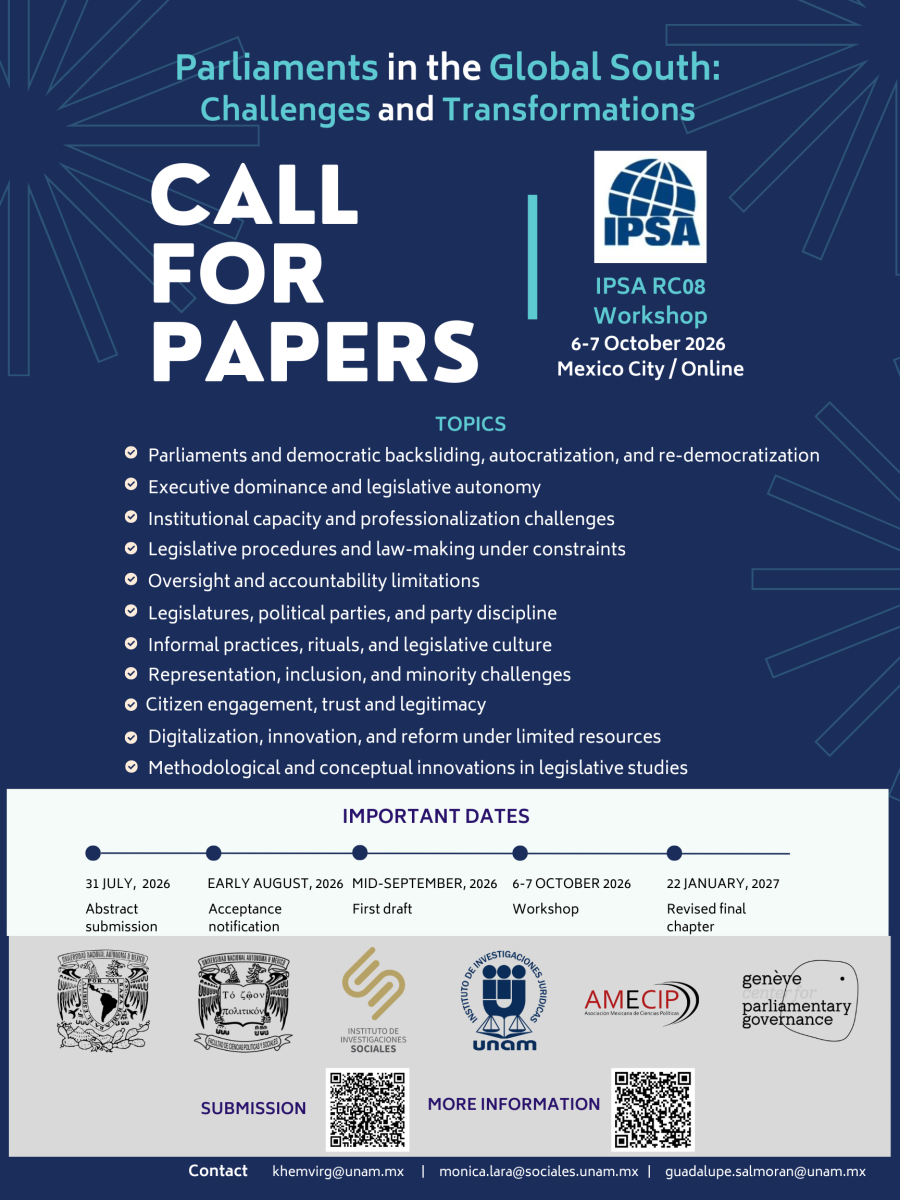
IPSA RC08 Workshop - Parliaments in the Global South: Challenges and Transformations
Tue, 06 Oct 2026 - Wed, 07 Oct 2026
Mexico City, Mexique
View Call for Proposals for this Event
Organized by: IPSA RC08, UNAM, AMECIP, Geneva Center for Parliamentary Governance
Contact: khemvirg@unam.mx
Parliaments across the Global South face a range of structural, political, and institutional challenges that shape their capacity to represent citizens, legislate effectively, and hold governments accountable. While legislatures remain constitutionally central institutions, they often operate under conditions of executive dominance, democratic erosion, authoritarian governance, institutional fragility, limited resources, and declining public trust.
Recent scholarship on democratic backsliding and regime change has largely focused on executives, courts, and electoral processes, frequently treating legislatures as secondary actors. Moreover, many theoretical frameworks used to analyze legislatures derive from experiences in consolidated democracies, often overlooking the distinctive trajectories, constraints, and innovations emerging from the Global South.
This workshop places these challenges at the center of analysis. It seeks to examine how parliaments in the Global South confront structural constraints, adapt to changing political environments, and shape processes of democratic resilience, institutional transformation, and governance. By focusing on challenges and responses, the workshop aims to generate new comparative and multidisciplinary insights into legislative politics beyond conventional models.
The workshop has two main objectives. First, it aims to advance comparative and interdisciplinary research on the challenges facing legislatures in the Global South. Second, it seeks to develop a coherent set of contributions for an edited volume to be proposed to a leading academic publisher. Participants are therefore expected to contribute both individual papers and to engage in the broader collective project.
We welcome contributions addressing, among others, the following questions:
- What are the main institutional and political challenges facing parliaments in the Global South?
- How do legislatures respond to democratic erosion, autocratization, or hybrid regimes?
- Under what conditions do parliaments act as arenas of resistance, adaptation, or legitimation?
- How do resource constraints, high turnover, and informal practices shape legislative performance?
- What challenges affect representation, accountability, and legislative authority?
- How do legislatures address declining trust, polarization, and citizen disengagement?
Scope and Themes
We invite proposals addressing legislatures in Africa, Latin America, West Asia, South Asia, Southeast Asia, and other regions commonly grouped under the Global South. Contributions may focus on single cases or comparative perspectives. Interdisciplinary approaches drawing on political science, sociology, law, political anthropology, and related fields are particularly welcome.
Indicative themes include:
- Parliaments and democratic backsliding, autocratization, and re-democratization;
- Executive dominance and legislative autonomy;
- Institutional capacity and professionalization challenges;
- Legislative procedures and law-making under constraints;
- Oversight and accountability limitations;
- Legislatures, political parties, and party discipline;
- Representation, inclusion, and minority challenges;
- Citizen engagement, trust, and legitimacy;
- Digitalization, innovation, and reform under limited resources;
- Informal practices, rituals, and legislative culture;
- Methodological and conceptual innovations in legislative studies.
Format and publication project
The workshop will be held in hybrid format, in person at the Social Research Institute (IIS) and the Legal Research Institute (IIJ) at the National Autonomous University of Mexico (UNAM) in Mexico City and online via Zoom, on October 6 and 7, 2026. It is conceived as a book-oriented workshop. Selected participants will be invited to develop their papers into chapters for an edited volume to be proposed to a leading academic publisher. Participants must commit to submitting a full draft prior to the workshop and to participating in a structured revision process.
Key dates
- Abstract submission (300–500 words): 31 July 2026
- Notification of acceptance: Early August 2026
- First draft: mid-September 2026
- Workshop: 6–7 October 2026
- Revised final chapter: 22 January 2027
Submission guidelines
Abstracts should outline the research question, theoretical approach, empirical material, and relevance to the workshop theme. Qualitative, quantitative, and mixed methods approaches are welcome. For the edited volume, manuscripts should follow the Harvard reference style.
Abstracts will be evaluated by a committee of experts based on scholarly quality, thematic relevance, and coherence with the collective project. Given the book-oriented nature of the workshop, acceptance will be selective. Further information will be shared with accepted participants. Participation will be limited to ensure intensive
discussion.
In its selection process, the committee will consider not only scholarly quality and thematic relevance, but also the overall coherence and diversity of the workshop and volume. This includes seeking a balanced representation across regions of the Global South, methodological pluralism, and diversity among contributors, including gender balance.
Abstract submission
Please submit your abstract (300–500 words) through the online submission form available at https://forms.gle/VTVu9BSvr2WHVKrg9
Further information regarding the venue, registration procedures, and editorial guidelines will be communicated to accepted participants. Participation will be limited
to ensure intensive discussion.
For any questions regarding the workshop, please contact the Organizing Committee:
Dr. Khemvirg Puente Martínez
khemvirg@unam.mx
Dra. Mónica Lara Escalante
monica.lara@sociales.unam.mx
Dra. Guadalupe Salmorán Villar
guadalupe.salmoran@unam.mx