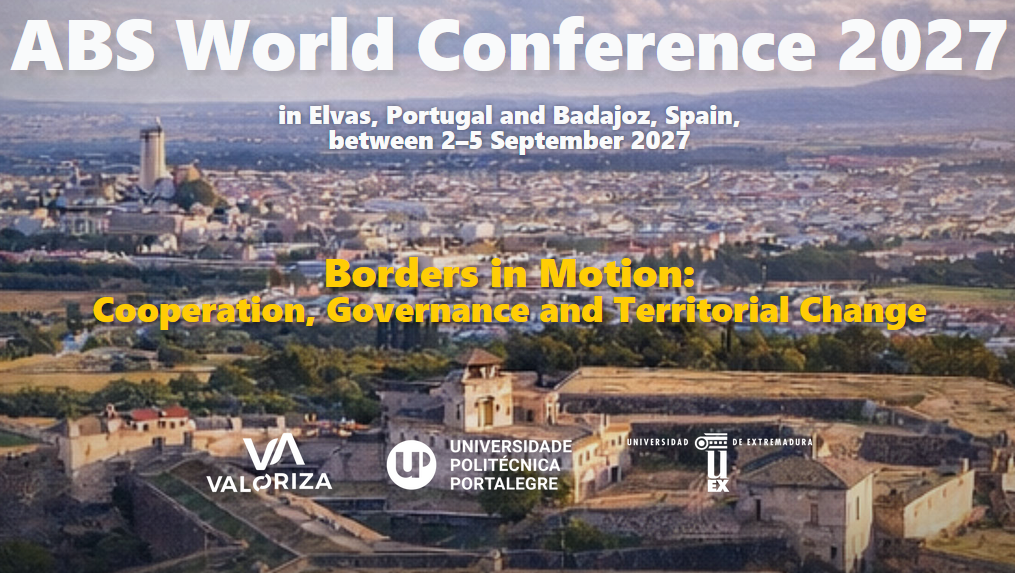
4th ABS World Conference
Thu, 02 Sep 2027 - Sun, 05 Sep 2027
Elvas, Portugal and Badajoz, Spain, Papouasie-Nouvelle-Guinée
View Call for Proposals for this Event
Organized by: Association for Borderlands Studies (ABS)
Contact: rui.castanho@upportalegre.pt
The Association for Borderlands Studies (ABS), Portalegre Polytechnic University (PPU), through VALORIZA Research Center, and the University of Extremadura (UEx) invite proposals for the 4th ABS World Conference. Bringing together scholars, students, practitioners and policymakers, the conference will explore how borders are produced, experienced and transformed across different regions and scales.Borders shape mobility, political authority, economic opportunity and everyday life. They are also sites of cooperation, conflict, cultural exchange and environmental interdependence. As territorial relations change, borderlands offer a critical vantage point from which to examine unequal access to resources and rights, the reconfiguration of governance, questions of sovereignty and self-determination and competing visions of territorial futures.
Hosted across the Portugal–Spain border in Elvas and Badajoz, the conference invites dialogue between research and practice and between border experiences worldwide. The Iberian setting provides a point of departure for comparative discussion; contributions addressing all world regions are welcome. We encourage theoretical, empirical, methodological and practice-based work across the humanities and social sciences and related fields, including comparative, interdisciplinary and innovative methodological approaches to the study of borders and borderlands. The conference welcomes submissions from established and early-career researchers, postgraduate students, practitioners and policymakers.
Suggested thematic areas:
- Border theory, methodologies, ethics and comparative perspectives;
- Cross-border cooperation, institutions and multilevel governance;
- Borderland transformations, spatial planning, border cities and rural borderlands;
- Migration, mobility, citizenship, rights and inclusion;
- Sovereignty, geopolitics, security, conflict and border control;
- Border economies, labor, trade, infrastructure and regional inequalities;
- Climate change, shared ecosystems, resources, environmental justice and more-than-human borderlands;
- Identities, culture, heritage, memory, everyday bordering and questions of race, gender and belonging;
- Indigenous borderlands, sovereignty, self-determination, territoriality and decolonial perspectives;
- Digital borders, surveillance, data governance and technological change.
These areas are indicative rather than restrictive. Proposals engaging other substantive questions in border and borderlands studies are welcome.