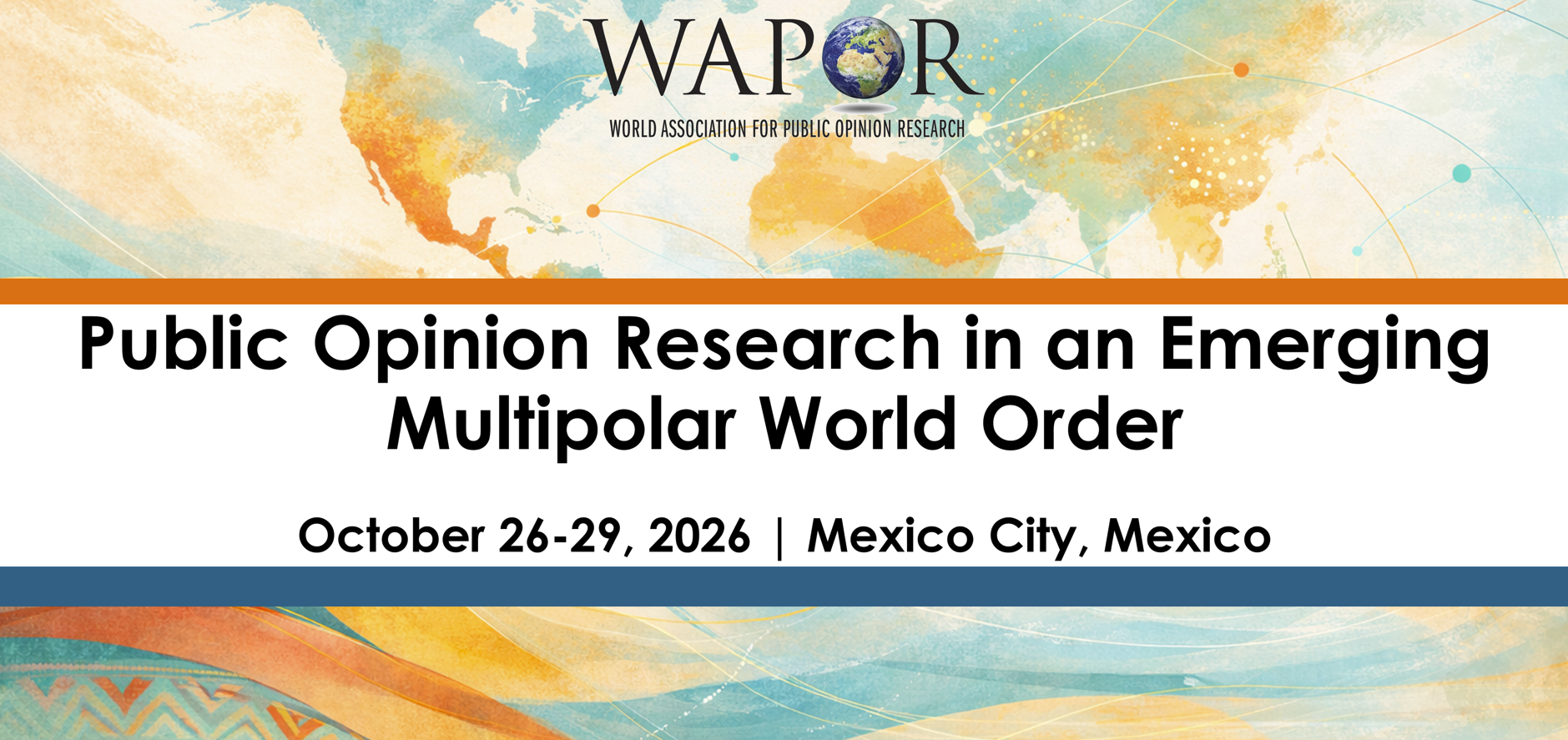
WAPOR 2026 Conference: Public Opinion Research in an Emerging Multipolar World Order
Contact: admin@wapor.org
Deadline: Fri, 01 May 2026
The World Association for Public Opinion Research is excited to announce that the Call for Abstracts is now officially open for the 79th Annual WAPOR Conference, taking place October 26-29, 2026, in the heart of Mexico City! As the world’s leading forum for public opinion and survey research, WAPOR 2026 offers a unique space to share your work, engage with global experts, and explore the latest methodological trends. This year’s meeting will be hosted at the Barceló México Reforma hotel. We invite submissions for paper and poster presentations, and pre-organized panels. Abstracts can be submitted via the WAPOR Membership and Conference Platform: https://access.wapor.org/ (Login=>Events=>WAPOR 2026).
For more information, please check the conference homepage: https://wapor.org/events/annual-conference/current-conference/
Conference Theme – Public Opinion Research in an Emerging Multipolar World Order
Today, the world is characterized by a complex and contested multipolarity in which economic and political power are increasingly distributed across regions. Across Africa, geopolitical competition intersects with regional integration and diverse political trajectories. China and India anchor Asia’s rise; the Middle East is marked by overlapping rivalries and temporary alignments among powers such as Turkey, Iran, and Saudi Arabia; Russia’s assertive military actions in its neighborhood, combined with strategic use of energy resources, have reshaped its relations with Europe and heightened geopolitical tensions.; and Latin America, with countries like Brazil and Mexico, seeks a more autonomous role amid shifting global alignments. Simultaneously, the resurgence of authoritarian movements and deepening ideological cleavages within and between states challenge the assumptions of liberal democracy and global consensus.
This new landscape demands a reassessment of how public opinion research is organized and conceptualized and used to compare attitudes across societies with different historical trajectories and systems of governance. Questions of cross-cultural comparability, conceptual equivalence, and the interpretation of global and regional opinions toward democracy, globalization, or international institutions have become more complex in an era of competing political narratives and epistemic pluralism.
Methodologically, multipolarity challenges the long-standing dominance of Western survey traditions and sampling models. Comparative research must now engage with multi-polar epistemologies—approaches that reflect diverse linguistic, cultural, and ideological contexts, as well as non-Western understandings of collective identity and social cohesion. Digital transformations, new social media environments, and regional information spheres further challenge contemporary public opinion research in modes of conceptualizing, measuring and comparing attitudes across the world.
Mexico City, as the site of this conference, provides an ideal vantage point for such reflections. Situated in a region that bridges North and South, embedded in transnational cultural and economic networks, and shaped by a vibrant tradition of public debate, Mexico offers both analytical insight and symbolic relevance for rethinking the future of public opinion research. Our annual conference invites contributions exploring how public opinion research can adapt to the emerging multipolar order—rethinking its theories, methodologies, and interpretive frameworks to better capture the plurality of voices shaping the global public sphere in the twenty-first century.
For WAPOR 2026, it is essential to reflect more deeply on how high-quality public opinion research can be ensured in an era of uncertain geopolitical developments and growing authoritarian tendencies. We also need to reassess our strategies for achieving comparable results across different cultural contexts, particularly regarding the appropriateness of theoretical approaches, measurement concepts, and sampling strategies. Moreover, it is crucial to advance innovative methodological approaches that address these challenges and make use of new technical developments and emerging methods for collecting and analyzing public opinion data.
Join us in Mexico City this October to discuss these important points!
Sincerely,
WAPOR Secretariat
https://wapor.org/
https://www.facebook.com/WAPORNET/
https://twitter.com/WAPOR
https://www.linkedin.com/company/wapor