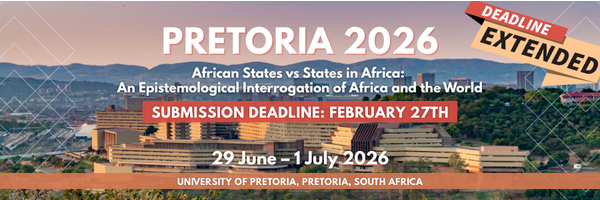
African States vs States in Africa: An Epistemological Interrogation of Africa and the World
Mon, 29 Jun 2026 - Wed, 01 Jul 2026
Pretoria, Afrique du Sud
View Call for Proposals for this Event
Organized by: International Studies Association & African Association of Political Science
Contact: Pretoria2026@isanet.org
ISA, the University of Pretoria, the African Association of Political Science (AAPS), and the Global South Caucus of International Studies (GSCIS) invite proposals for the 2026 ISA Midyear Conference, hosted at the University of Pretoria. This year’s theme, “African States vs. States in Africa: An Epistemological Interrogation of Africa and the World,” encourages scholars to engage critically with the political, historical, and epistemic dimensions of Africa’s place in global affairs.
In over six decades since the wave of political independence that swept across Africa mainly in the 1960s, the continent has remained entangled in the structures and narratives of a global order it was not part of designing. Indeed, while states in Africa, masquerading as African states, acquired juridical sovereignty, their agency and epistemic presence in world politics remain constrained by systemic hierarchies embedded in international relations theory and practice. The conceptual distinction between African States and States in Africa provides an analytical entry point into this paradox. The concept of African State implies self-defining, autonomous actors that derive legitimacy from indigenous political, cultural, and historical contexts. On the other hand, States in Africa reflect entities whose existence, purpose, performance, and recognition are defined by external systems of power, norms, and knowledge production with little or no inputs from citizens.
This raises a number of ideational questions at three intersecting dimensions of analysis.
- Epistemologically, how has Africa been known, represented, and theorized in IR scholarship? What are the implications of Euro-American epistemic dominance for African agency and global participation?
- Ontologically, what defines the being of the state in Africa and notion of the African state? Is it juridical recognition, colonial cartography, or endogenous legitimacy?
- At a more practical level of geoeconomics, how do African states navigate Wesern-led global governance systems (UN, G20, IMF, WTO) that were not designed with their participation in mind, and what does that reveal about “being” versus “existing” in international politics?
Together, these questions invite a rethinking of Africa’s global agency - from a peripheral participant to a central actor in reconstituting the international system.
This conference therefore seeks to interrogate this ideational tension which not only sheds light on state and governance failures in Africa, but also provides an insight into the question of Africa’s marginal role as a passive subject of world order and politics. It hopes to unravel whether states in the continent transcend externally imposed categories of statehood and international legitimacy including the forms of knowledge, diplomacy, and cooperation they require to re-centre Africa in global IR. The idea is to build on the growing scholarship on African IR to refine and enhance the science and practice of IR globally and to reclaim Africa as both a site and source of theory, not merely a field of empirical illustration.
Based on the foregoing, the specific objectives of the conference include to:
- Underscore the nexus between domestic and foreign policies by interogating state formation, governance and state-making in Africa as well as comparatively, and their impact on the continent’s agency in global affairs;
- Interrogate the epistemological foundations of how Africa is positioned in global knowledge systems, especially in IR theory and practice;
- Examine the gap between juridical sovereignty and epistemic sovereignty among African states and comparatively;
- Revisit African contributions to global thought, diplomacy, and institutional design;
- Propose frameworks for theorizing Africa as a co-producer of global order, rather than a subject of it;
- Foster dialogue between African and international scholars on decolonial, postcolonial, and Global South perspectives in world politics alongside those in diplomacy, intranational organizations and law, development, peace, global social movements, security studies, and elsewhere.
It welcomes panel proposals, abstracts and roundtable submissions addressing notably (but not limited to) other related issues such as:
- The processes of Eurocentrism in IR theory and the need for epistemic decentralization and multiplication;
- African intellectual traditions and alternative epistemologies of order, peace, and security;
- The bifurcation between juridical and empirical statehood in Africa and elswehere;
- Reinventing the state, sovereignty and governance in Africa and through studies that focus on Africa and other regions of the world struggling with statehood;
- Africa’s role in shaping diplomacy, international norms, and governance (Ezulwini Consensus, AU Peace and Security Architecture, AfCFTA);
- Africa’s engagement with global powers from summit diplomacy to strategic partnerships and hedging;
- Geoeconomics and the political economy of critical minerals, debt, and trade asymmetries;
- Africa’s structural position in global capitalism and emerging multipolarity and multiplexity;
- The role of epistemic communities, think tanks, and universities in re-imagining and learning from African agency;
- Common African Positions (CAPs) as instruments of epistemic and diplomatic sovereignty;
- Other conceptual and analytical frameworks for capturing nuances and complexities of international life in and from Africa.